
EVA protective cases have become a popular solution for protecting and organizing portable products across industries, from consumer electronics and photography equipment to medical devices, professional tools, and outdoor accessories. Their combination of lightweight construction, cushioning performance, structural support, and customizable design makes them a practical alternative to many traditional soft bags and rigid protective cases.
But what exactly is an EVA protective case? What materials are used in its construction? How does its design affect product protection, and which applications benefit most from EVA foam? As product packaging and equipment protection continue to evolve, what trends should manufacturers, brands, and purchasing teams pay attention to?
This guide explores EVA protective cases from multiple perspectives, including material properties, structural design, key features, manufacturing processes, industry applications, and future development trends.
1. What Is an EVA Protective Case?
EVA stands for ethylene-vinyl acetate, a copolymer widely used in foam products, cushioning materials, footwear, sports equipment, and protective packaging.
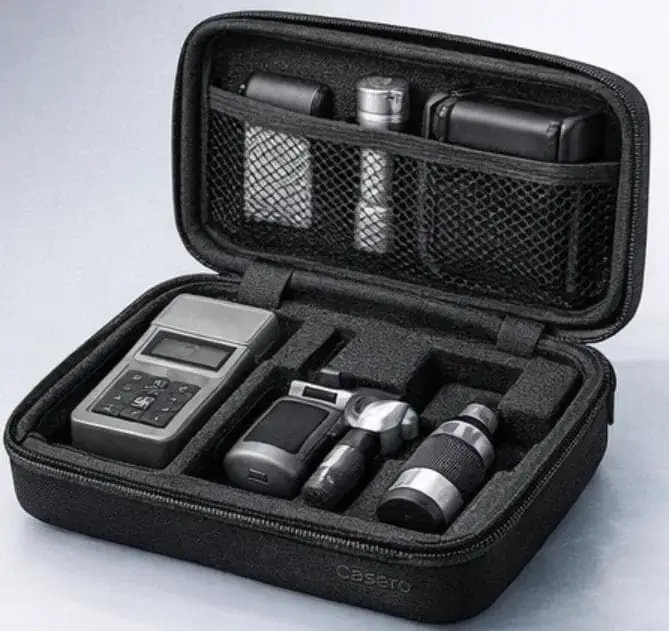
An EVA protective case is typically made using EVA foam as a structural or cushioning layer. Depending on the intended application, the foam can be combined with fabric, synthetic leather, an inner lining, zippers, and custom-shaped inserts to create a lightweight, semi-rigid enclosure.
Unlike a simple fabric pouch, an EVA case is designed to maintain its shape and provide additional support. Compared with some traditional rigid plastic cases, it can offer a lighter and more flexible construction, depending on the materials and design.
A typical custom EVA protective case may contain several components:
- EVA foam core: Provides structural support, cushioning, and shape retention.
- Outer covering: Materials such as polyester, nylon, PU, or other suitable textiles can improve appearance and surface durability.
- Inner lining: Helps create a finished interior and reduce direct contact between the case structure and the stored product.
- Custom foam insert: Holds the product and accessories in designated positions.
- Zippers and accessories: Provide access and may include handles, elastic straps, mesh pockets, dividers, and other functional features.
The exact construction depends on the product being protected, the expected handling conditions, the target price, and the desired appearance.
Suggested image 1: EVA protective case construction
Image concept: An open EVA protective case showing the outer fabric, semi-rigid EVA shell, inner lining, custom foam insert, and zipper.
2. Understanding EVA Material and Its Properties
Choosing the right EVA material is an important part of protective case design. Although EVA is often described as a single material, its performance can vary according to its formulation, foam structure, density, hardness, thickness, and manufacturing process.
Understanding these differences helps designers and purchasing teams select a construction that matches the product’s protection requirements.
2.1 Lightweight Construction
One of the main advantages of EVA foam is its ability to provide cushioning and structural support without the weight of many solid materials.
This makes EVA protective cases suitable for portable products that need to be carried frequently, including wireless headphones, cameras, chargers, handheld instruments, and small electronic devices.
For products shipped internationally, reducing unnecessary weight and package dimensions can also help improve transport efficiency. However, the final weight depends on the complete case, including the covering, hardware, and internal accessories.
2.2 Cushioning and Shock Absorption
EVA foam can compress under impact and absorb part of the energy generated by a collision. When combined with a suitable shell structure and properly designed internal support, it can help reduce the risk of damage during routine handling and transportation.
However, shock absorption is not determined by foam thickness alone. Density, hardness, compression behavior, wall geometry, and the way the product is held all influence the result.
For fragile or high-value equipment, the finished case should be evaluated under realistic handling conditions. Drop tests, vibration tests, or transport tests may be appropriate depending on the intended use.
2.3 Flexibility and Shape Retention
EVA foam can be formulated to provide different levels of flexibility and firmness.
A softer grade may be useful where cushioning and flexibility are important, while a firmer grade may help maintain the shape of a semi-rigid protective case. The appropriate balance depends on the weight, shape, and fragility of the contents.
The goal is not to choose the hardest material available. Instead, the material should support the case structure while providing the required level of cushioning.
2.4 Moisture Resistance
EVA foam commonly has a closed-cell structure that limits water absorption compared with many open-cell foams. This can be beneficial for products exposed to occasional moisture.
Nevertheless, moisture-resistant EVA foam does not automatically make an entire protective case waterproof.
Water may enter through zippers, seams, joints, or openings. If the case will be used outdoors or in wet environments, the complete construction should be evaluated against the required level of water protection.
2.5 Customization Potential
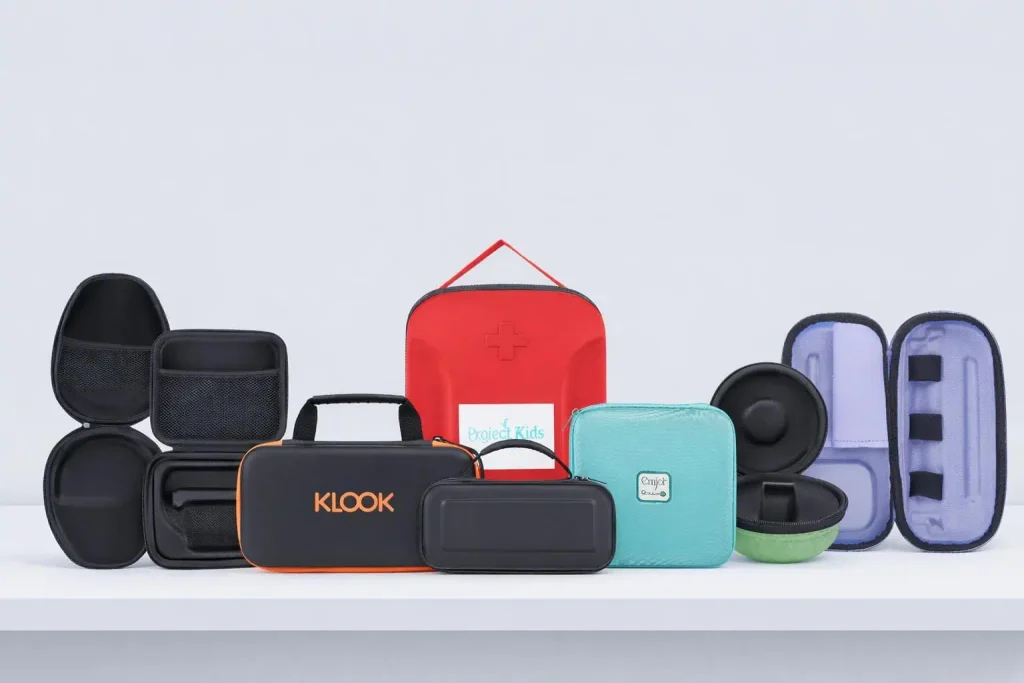
EVA foam can be cut, laminated, molded, and shaped for different applications. Depending on the construction, manufacturers can develop custom sizes, contours, internal compartments, and surface finishes.
Customization may include:
- Different shell shapes and dimensions
- Multiple colors and outer covering materials
- Custom-cut or molded foam inserts
- Internal dividers and accessory compartments
- Printed logos, embossed branding, or other suitable logo applications
- Zippers, handles, straps, and additional storage features
These options make EVA cases useful for both functional equipment protection and brand-specific product presentation.
3. EVA Protective Case Design: What Matters Most?
A successful EVA case design must balance protection, usability, appearance, manufacturability, and cost. A case may look attractive but still perform poorly if its internal space, foam specifications, or closure system are not properly designed.
3.1 Product Dimensions and Internal Layout
The first step is to understand the product’s actual dimensions and shape.
Designers should identify the product’s length, width, height, protruding components, ports, buttons, and any accessories that need to be stored alongside it.
If the internal cavity is too large, the product may move around during transport. If it is too tight, the product may be difficult to insert or remove, and unnecessary pressure may be applied to sensitive components.
For products with several accessories, the layout should keep each item organized and prevent contact between components.
3.2 EVA Foam Density, Hardness, and Thickness
Three important considerations are density, hardness, and thickness.
| Design factor | What it affects | What to consider |
|---|---|---|
| Foam density | Weight, firmness, and structural behavior | Product weight and required support |
| Foam hardness | Resistance to deformation and overall feel | Whether the case needs a firmer shell or softer cushioning |
| Foam thickness | Available cushioning space and overall case size | Impact requirements, internal clearance, and portability |
| Shell geometry | Shape retention and load distribution | Curves, corners, edges, and pressure points |
| Insert design | Product positioning and separation | Product shape, accessories, and ease of removal |
These factors work together. Increasing thickness may provide more cushioning space, but it can also increase the case’s dimensions. A harder foam may improve support but may not be ideal for every contact surface.
The appropriate specification should be selected according to the application and validated through prototype testing when necessary.
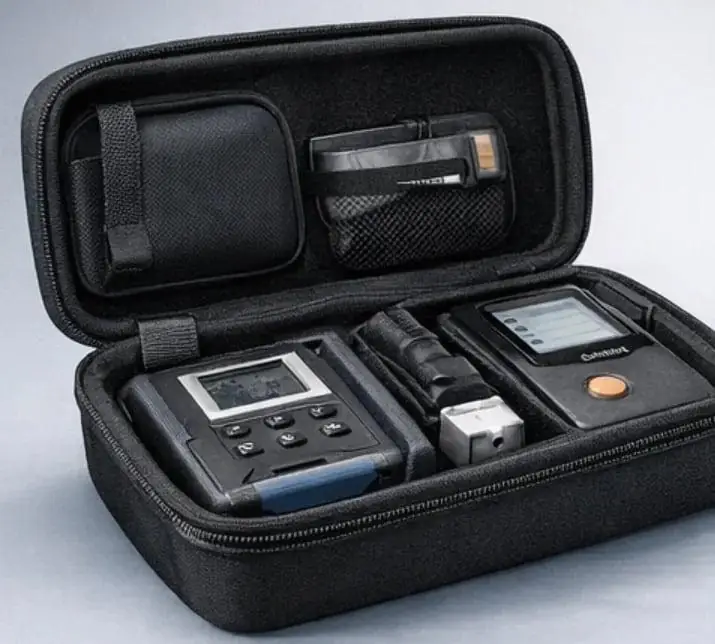
3.3 Custom Foam Inserts
A custom foam insert helps keep the contents in a defined position inside the case.
Common options include die-cut foam, CNC-cut cavities, molded inserts, layered foam structures, and combinations of foam with fabric pockets or elastic straps.
The design should account for:
- The shape and weight of each component
- The clearance required for easy removal
- The distance between separate accessories
- The locations of fragile surfaces and protruding parts
- The expected frequency of opening and closing
- The ease of cleaning and replacing the insert, if relevant
For precision instruments and electronic devices, an accurately designed insert can improve organization and reduce unwanted movement.
3.4 Outer Materials and Surface Finishes
The outer covering affects the case’s appearance, texture, abrasion resistance, cleaning requirements, and branding options.
| Outer material | Typical characteristics | Potential applications |
|---|---|---|
| Polyester fabric | Versatile and available in many colors | Consumer electronics and everyday accessories |
| Nylon fabric | Suitable for many portable and utility products | Tools, equipment, and outdoor accessories |
| PU synthetic leather | Offers a smooth or leather-like appearance | Premium consumer products and branded accessories |
| Coated or laminated textiles | Can provide specific surface properties depending on the construction | Cases requiring particular appearance or surface performance |
These are general material-selection considerations, not guarantees of finished-product performance. The quality of the coating, lamination, seams, and forming process can affect the final result.
Logo options may include printing, embossing, debossing, labels, and other techniques compatible with the selected outer material.
3.5 Zippers, Seams, and Opening Design
Zippers and seams influence everyday usability and the overall integrity of an EVA case.
Designers should consider the opening direction, zipper length, ease of operation, seam placement, handle position, and the space needed to remove the product safely.
For products used frequently, the closure should be evaluated for smooth operation and durability. For cases intended for outdoor use, the complete closure design must also be considered when assessing moisture protection.
3.6 Design for Manufacturing
A design that works in a digital drawing or prototype may still require adjustments before mass production.
Manufacturing feasibility depends on the selected forming process, foam characteristics, mold geometry, covering materials, seam construction, and assembly sequence.
Early communication between the designer and manufacturer can help identify difficult contours, unnecessary material use, inconsistent dimensions, and features that increase production complexity.
Suggested image 2: Custom EVA case design process
Image concept: A three-part visual showing a product dimension drawing, a custom foam insert prototype, and the finished EVA protective case.
Suggested image alt text: Custom EVA protective case design process from product dimensions to foam insert and finished case
4. Key Features and Benefits of EVA Protective Cases
EVA protective cases are used in many industries because they offer a combination of practical features.
| Feature | Practical benefit | Important consideration |
|---|---|---|
| Lightweight construction | Easier to carry and transport | Total weight includes fabric and hardware |
| Cushioning performance | Helps reduce impact forces | Requires suitable foam specifications and testing |
| Semi-rigid structure | Supports shape retention | Depends on the complete shell construction |
| Custom internal layout | Keeps products and accessories organized | Must match actual product dimensions |
| Flexible appearance options | Supports different brand identities | Surface finishes depend on material compatibility |
| Moisture-resistant foam | Can limit water absorption by the foam | Does not guarantee a waterproof finished case |
| Reusable design | Supports repeated storage and transport | Service life depends on use, materials, and construction |
The most suitable EVA case is not necessarily the one with the greatest thickness or the most expensive surface finish. It is the one that provides the appropriate level of protection and usability for its intended purpose.
5. EVA Protective Cases vs. Fabric Bags and Hard Plastic Cases
EVA cases occupy a useful middle ground between flexible fabric bags and many rigid protective cases.
The following comparison provides a general starting point for material selection.
| Comparison | EVA protective case | Fabric bag | Hard plastic case |
|---|---|---|---|
| Structure | Usually semi-rigid | Usually flexible | Usually rigid |
| Cushioning | Can be integrated into the foam structure | Depends on added padding | Often requires a separate cushioning insert |
| Portability | Often lightweight | Often lightweight and flexible | Varies by material and design |
| Shape retention | Generally better than an unstructured pouch | Usually limited without reinforcement | Generally strong |
| Internal customization | Suitable for shaped foam cavities and dividers | Suitable for pockets and sewn compartments | Suitable for custom inserts and dividers |
| Surface customization | Fabric, color, logo, and finish options | Fabric and printing options | Molded surfaces, coatings, labels, and other finishes |
| Common applications | Portable electronics, instruments, and accessories | General storage and lightweight items | Equipment requiring a rigid enclosure |
No single option is best for every application. A fabric bag may be sufficient for lightweight items that need basic storage. An EVA case may be suitable when cushioning, shape retention, and portability are all important. A rigid plastic case may be more appropriate where greater structural rigidity or a specialized enclosure is required.
The final decision should be based on product fragility, expected handling, environmental conditions, budget, and testing requirements.
6. Applications of EVA Protective Cases Across Industries
EVA cases can be customized for a wide range of products. Their suitability depends on the required protection level, case dimensions, internal layout, and manufacturing method.
6.1 Consumer Electronics
Electronic accessories are among the common applications for EVA protective cases.
Examples include:
- Wireless headphones and earbuds
- Chargers, cables, and power accessories
- Camera accessories
- Gaming controllers and related equipment
- Portable electronic devices
These products often benefit from compact storage, organized compartments, and cushioning around sensitive components.
Suggested image 3: EVA case for electronic accessories
Image concept: An open, compact EVA case containing wireless headphones, a charging cable, and a small accessory, with each item held in a dedicated compartment.
Suggested image alt text: Custom EVA protective case for wireless headphones and electronic accessories
6.2 Medical and Healthcare Equipment
Portable medical and healthcare equipment may require organized storage and protection during transportation.
Potential applications include portable monitoring devices, testing instruments, personal healthcare equipment, and related accessories.
Design considerations may include secure positioning, easy access, cleanable surfaces, and the separation of individual components. Any specific hygiene, chemical-resistance, or regulatory requirements must be assessed for the actual product and destination market.
6.3 Professional Tools and Measuring Instruments
Technicians and field-service professionals often need to transport tools and instruments between locations.
A custom EVA case can organize individual tools in designated cavities, helping users identify missing items and reducing movement during transportation.
Potential applications include measuring instruments, inspection equipment, repair tools, and specialized accessories.
6.4 Photography and Outdoor Equipment
Photography accessories and selected outdoor products may benefit from lightweight protection and organized storage.
Examples include camera accessories, compact electronic devices, portable outdoor tools, and cycling-related accessories.
The design should reflect the actual environment in which the product will be used. Equipment exposed to heavy rain, dust, or severe impact may require additional protective features and testing beyond a standard EVA case.
6.5 Consumer Products and Branded Gift Sets
EVA cases can also be developed for branded accessories, promotional kits, product bundles, and premium gift sets.
Coordinating the exterior color, logo, internal layout, and accessory placement can create a more consistent presentation while keeping the contents organized.
For brands and distributors, the design should balance appearance with practical considerations such as production quantity, durability, packaging dimensions, and shipping costs.
7. How Are EVA Protective Cases Manufactured?
The manufacturing process varies according to the case design, materials, and required production volume. A typical custom project may involve the following stages.
Step 1: Product Assessment
The manufacturer reviews product dimensions, photographs, technical drawings, or 3D files.
The project brief should identify the product’s weight, fragile areas, accessories, expected handling conditions, target quantity, and appearance requirements.
Step 2: Material Selection
The appropriate EVA foam, outer covering, lining, zipper, and insert materials are selected.
Material choices should reflect the balance between cushioning, structural support, surface quality, weight, and budget.
Step 3: Structural Design and Prototyping
The case shape, internal cavities, opening, and accessory layout are developed.
A prototype allows the team to evaluate product fit, ease of removal, appearance, and assembly feasibility before moving into mass production.
Step 4: Forming, Cutting, and Assembly
Depending on the construction, manufacturing may include foam cutting, lamination, heat pressing or compression molding, trimming, sewing, zipper installation, and final assembly.
Not every EVA case uses the same process. Some designs rely on formed semi-rigid shells, while others use laminated foam and fabricated fabric panels.
Step 5: Quality Inspection
The finished case should be checked against agreed specifications.
Typical inspection points include dimensions, surface appearance, seams, zipper operation, internal fit, logo placement, and accessory installation.
If the application requires specific impact or environmental performance, the appropriate tests should be defined and conducted on representative finished samples.
Step 6: Mass Production and Consistency Control
After the prototype is approved, production requirements should be documented to help maintain consistency across batches.
Clear specifications for materials, dimensions, colors, workmanship, packaging, and acceptance criteria reduce the risk of misunderstandings between the buyer and manufacturer.
8. How to Choose the Right EVA Protective Case Manufacturer
For brands, importers, product developers, and purchasing teams, selecting a manufacturer involves more than comparing unit prices.
The following questions can help evaluate a potential supplier:
| Evaluation area | Questions to ask |
|---|---|
| Custom design | Can the supplier work from samples, drawings, or 3D files? |
| Material knowledge | Can the supplier explain the available foam, covering, and lining options? |
| Prototype development | Can the design be reviewed and adjusted before mass production? |
| Quality control | Are dimensions, materials, appearance, and workmanship checked against defined criteria? |
| Production capability | Can the supplier maintain consistency across the expected order quantity? |
| Communication | Are specifications, lead times, packaging, and acceptance standards clearly documented? |
When requesting a quotation, provide as much information as possible, including product dimensions, reference photographs, expected order quantity, preferred materials, logo requirements, and intended use.
A complete project brief helps suppliers make more accurate assessments and makes quotations easier to compare.
9. Future Trends in EVA Protective Case Development
As portable devices, professional equipment, and consumer accessories continue to evolve, EVA protective case design is likely to place greater emphasis on application-specific performance, customization, manufacturing efficiency, and material responsibility.
These are important areas to watch, although the pace of adoption will vary by industry and product category.
9.1 More Precise and Product-Specific Design
As products become smaller and more specialized, generic storage solutions may not provide the best fit.
Custom internal cavities, improved compartment layouts, and better integration of accessory storage can help create a more practical user experience.
Digital product models and prototype iterations can also help designers identify fit issues before mass production.
9.2 Lightweight Design Without Unnecessary Material
Reducing weight can improve portability and may help lower transportation costs. However, removing material without evaluating the resulting structure can compromise performance.
Future designs will continue to benefit from balancing material use, wall geometry, cushioning requirements, and real-world handling conditions.
The objective is to use the right amount of material for the intended function rather than simply making every case thinner.
9.3 Greater Personalization and Brand Differentiation
Brands increasingly need packaging and accessories that reflect their product identity.
EVA cases can support customized colors, textures, logos, internal layouts, and accessory combinations. These features allow manufacturers to develop case designs for different product ranges and customer segments.
At the same time, designs should remain practical to manufacture and consistent in mass production.
9.4 Improved Testing and Quality Documentation
Product protection requirements can vary significantly between everyday accessories, precision instruments, and high-value equipment.
As a result, clear specifications and application-based testing are important parts of case development.
Instead of relying only on broad claims such as “shockproof” or “waterproof,” manufacturers and buyers can define measurable requirements, select suitable test methods, and document the performance of the finished product.
9.5 More Responsible Material and Lifecycle Decisions
Environmental considerations are becoming increasingly relevant to product and packaging development.
For EVA protective cases, responsible design can involve improving product durability, avoiding unnecessary material, extending useful service life, and assessing realistic end-of-life options.
It is important to recognize that EVA is not inherently biodegradable simply because it is used in a protective or packaging product. Its environmental impact depends on the formulation, manufacturing process, product lifetime, transport, and available end-of-life pathways.
Future improvements may involve better material traceability, more efficient production, longer-lasting products, and material choices that align with the recycling or disposal infrastructure available in the target market.
9.6 Closer Integration Between Design and Manufacturing
A protective case must work as both a product and a manufactured assembly.
Early collaboration between designers, engineers, and manufacturers can help reduce unnecessary complexity, identify assembly challenges, improve prototype accuracy, and establish realistic quality standards.
This approach is particularly valuable for custom projects that require a specific appearance, precise internal fit, or repeatable production across multiple batches.
10. Frequently Asked Questions About EVA Protective Cases
Is EVA a good material for protective cases?
EVA can be a good choice when a product needs a combination of cushioning, lightweight construction, and a semi-rigid structure. The best choice depends on the product’s weight, fragility, operating environment, and protection requirements.
Are EVA protective cases waterproof?
Not automatically. EVA foam generally has low water absorption, but a finished case may allow water to enter through its zipper, seams, joints, or openings. A waterproof claim should be supported by testing of the complete case under defined conditions.
Are EVA cases better than hard plastic cases?
Neither option is universally better. EVA cases often offer a useful balance of cushioning and portability, while hard plastic cases may provide greater rigidity. The appropriate choice depends on the product, expected impact, environment, and budget.
Can EVA protective cases be customized?
Yes. Depending on the manufacturing method, customization can include dimensions, shell shape, foam hardness, internal cavities, outer fabric, lining, color, logo, zippers, handles, and accessory compartments.
What products can be stored in EVA cases?
Common examples include electronic accessories, camera equipment, portable instruments, selected medical devices, professional tools, and outdoor accessories. The internal structure should be designed for the actual product and its handling requirements.
How do I choose the right EVA foam thickness?
There is no single thickness that works for every product. The appropriate thickness depends on the product’s dimensions, weight, fragility, available internal space, foam properties, and expected impact conditions. Prototype evaluation and testing can help establish a suitable specification.
Are EVA protective cases environmentally friendly?
Their environmental impact depends on material composition, durability, production efficiency, and end-of-life options. EVA should not automatically be described as biodegradable. Buyers with specific environmental targets should evaluate the complete product and its realistic disposal or recovery pathways.
Conclusion
EVA protective cases provide a versatile option for products that need cushioning, organized storage, portability, and a degree of structural support. Their applications range from consumer electronics and photography accessories to professional instruments, selected medical equipment, and branded product sets.
However, the performance of an EVA case depends on more than the material name. Foam density, hardness, thickness, shell geometry, outer covering, internal insert design, and closure construction all contribute to the finished result.
For a successful custom project, begin with the product’s actual dimensions and protection requirements. Select materials according to the intended application, review a prototype, and define quality and testing criteria before mass production.
By combining thoughtful material selection with practical design and manufacturing control, businesses can develop EVA protective cases that meet functional requirements while supporting a consistent product and brand experience.